Tuesday, February 24, 2009

Built for love...

The Taj Mahal is the symbol of eternal love. The story is that this beautiful structure was built by one of the most powerful emperors in the history of India for the memory of his most beloved wife. Emperor Shahajehan had built many architectural marvels in his career, but Taj Mahal is the zenith. The world heritage site and the seventh architectural wonder of the world, Taj Mahal is different from the rest. The emperor loved his wife Mumtaz dearly. At the age of fifteen, the prince who would be called King of the World met a refined and highborn young girl at a bazaar within the walls of the royal palace in Agra. Court poets celebrated the girl's extraordinary beauty. "The moon," they said, "hid its face in shame before her." For both, it was love at first sight. Five years would pass before the auspicious day chosen for their wedding, and from that moment, they became inseparable companions. When in 1631, she died giving birth to their 14th child; Shahajehan lost the will to live. It was then he decided to build a mausoleum for his beloved which the world would remember. And indeed the Taj Mahal is mesmerizing!!!

The Mughals were not only all powerful, but seriously rich. Jahan had become Emperor on his father's death in 1627 and the list of his possessions is unbelievable in terms of gold, silver, and precious gems. It was an age of outrageous opulence, and a time when some of the world's largest and most precious gems were being mined from India's soil. The making of the Taj involved thousands of skilled workers brought from all parts of the Mughal Empire. The beautiful white marble that was mined and brought 200 miles from the west by a crew of 1,000 elephants is inset with intricately cut gemstones. Red sandstone was brought from Fatehpur Sikri, Jasper from Punjab, Jade and Crystal from China, Turquoise from Tibet, Lapis Lazuli and Sapphire from Sri Lanka, Coal and Cornelian from Arabia and diamonds from Panna. In all 28 kind of rare, semi precious and precious stones were used for inlay work in the Taj Mahal. The construction took over 20,000 workers, 22 years to complete! By the time the work was done, Shah Jahan's eldest son, and heir to his throne, was already well into the planning stages of overthrowing his father's power. In 1658, his son declared himself Emporer and imprisoned him in a tower of the Agra Fort, where he spent his days peering across the river at his masterpiece Taj Mahal, where the tomb of his beloved wife lay. He spent 6 years, until his death, held at the Agra Fort. His tomb now lies beside his beloved Mumtaz, inside the walls of the Taj Mahal.

Knowing the history is such an important part of appreciating the beauty of the Taj Mahal. When Prince Charles and Princess Diana came to India in 1992, Prince Charles was too busy with "business" in Delhi (ahhh emm... Camilla Parker Bowles!!) to accompany the Princess on her Taj Mahal visit. This photograph speaks a thousand words about their dwindling relationship... as she sits, alone, at this grand monument, built for love.


AP Photo 1992

This bench is now known as the Lady Diana bench, and is the most popular "photo op" location at the Taj Mahal. We look pretty darn good on it, I think!
A few more photos from our visit... The marble stairs and tunnel leading up to the main platform of the Taj...

Taylor with a group of beautiful young ladies who wanted a photo with her...
And again, Taylor with 2 guys who took her picture with their cell phone cameras!
Pat and Mom marveling at the inscriptions from the Koran...
The sun setting behind one of the 4 pillars...
Inside... no photos allowed (oops!)...
Mom and Taylor trying to look cool (not working in those dorky booties!)...


OK, I seriously need to get some sleep, so more Taj pics and the Agra Fort post to come tomorrow!! Good night :)


Monday, February 23, 2009

Agra Trip - Taj Mahal here we come...

We have just returned from our whirlwind trip to see a little monument you might have heard of here in India - the Taj Mahal. Today I have a bit of what I am calling a "Taj hangover"... it is a small price to pay, I must say!! Bear with me on the blog side of this - there is sooooo much to talk about. I will devote this blog to the trip from Bangalore to the Taj and follow up tonight with an information and photo packed blog of the Taj/Agra Fort tours as well as the link to our Picasa site, where all 400+ (no, that is not a typo) photos from the trip will be!!
So, we were up by 4am, departing our villa at 4:45am for the Bangalore Airport. The ride to the airport is 50 kilometers (30 miles), which takes just under an hour with NO traffic... but can easily take 2 hours or more - so you always need to leave very early and hope or the best.
We arrived in plenty of time for Lauren to catch up with some of the security guards who adore her. Imagine what this conversation is about...
Next, it was onto what I like to call the runway bus, which carts us across runways and to our waiting plane. Next stop... Delhi - which is a 2.5 hour flight from Bangalore - straight north. It is the US equivalent of flying from Florida to NY. Notice the backpacks... continuing my art of light travel, we were able to pack everything we needed for a 3 day trip for 6 people into 3 backpacks!The arrival in Delhi was smooth... with no bags to collect at baggage claim, we were found our waiting driver and it was off to Agra.
Lauren was asleep 5 minutes into the drive...

Agra is about 185 kilometers from Delhi (114 miles), HOWEVER - yes, that is a big however... it is a 4 - 5 hour drive!!! They don't just plop the Taj Mahal down in an easy to get to place, you know. A few pics from the Delhi to Agra journey...h

Yes... those are chickens - can you say, "fresh poultry"?

We arrived at our hotel in Agra at 3pm. Our tour guide was there waiting and said we had about 15 minutes to get checked in and changed, or we couldn't fit in the tour with the day's sunlight. No problem! 15 minutes later we were back in the car. Our hotel was just 1.5 kilometers from the Taj Mahal... and gas powered vehicles are not allowed within a 1 kilometer radius of the monument (to prevent emissions from harming the marble), so in typical India style, we jammed ourselves inside of this battery powered car for the last kilometer...

Hawkers and beggars fill the street in the last few hundred meters before the Taj Mahal entrance. It is absolute pandemonium!!!!!! While we are used to it, to some extent, living in Bangalore... this is honestly times 1000. It is surely my record for saying "no" the highest number of times in 5 minutes - and that is saying a lot since I have 3 kids!!!!

So there we were... at the Taj entrance. A camera and a bottle of water. That is all they allow you to bring in. Our guide was Faizel... and he was great... Here he is leading Taylor and Andrew to the gate...

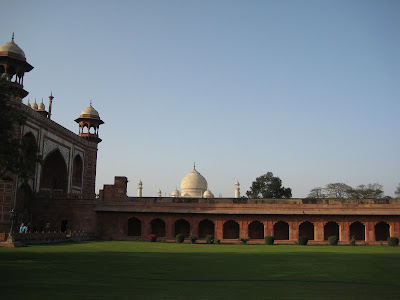
On the way, I caught a glimpse of the the Taj, peeking over the top of the wall...Taylor's first glimpse was through the arch... here she is pointing it out to Pat...Once you enter the main archway... the view is the one we have all seen so many times...So we made it! We were at the Taj Mahal!!

Tuesday, February 17, 2009

The many colors and styles of India...

I have thought so many times that I should post a blog about the way people dress here in India... this blog is waaaaayyyyy overdue. Oh, where to start?? It is so diverse, that describing it is more difficult than probably any other culture in the world! If you take a snapshot of a crowded street anywhere here in Bangalore, you see people from all walks of life, each with his/her own style. It is an almost even mix of barefoot vs. shoes, saree vs. jeans with kurtas, chinos vs. dhotis (aka the "man skirt"). All moving together in perfect harmony. Many people holding to centuries old traditional garb, many people having been completely "westernized" - maybe wearing a DKNY tee and Calvin Klein Jeans!! Can you imagine walking down 5th Avenue in NYC and seeing this...and this...
and this...
all together, and thinking it was completely normal?? This is as close as I can relate the variety we see here in India.
Salwar kameez is a traditional dress worn by both women and men in South Asia. Salvars or shalvars are loose pajama-like trousers. The legs are wide at the top, and narrow at the bottom. The kameez is a long shirt or tunic. The side seams (known as the chaak) are left open below the waist-line, which gives the wearer greater freedom of movement. In Afghanistan and , Pakistan and India, the garment is worn by both sexes.
When women wear the salwar kameez, they usually wear a long scarf or shawl called a dupatta around the head or neck. Here's Mom in one of her new "I am going to the Taj Mahal" salwar kameez outfits... I must say, she looks like a natural!!


The kids, in theirs...

A kurta is also a traditional item of clothing. It is a loose shirt falling either just above or somewhere below the knees of the wearer, and is worn by both men and women. They were traditionally worn with loose-fitting paijama (kurta-paijama), loose- salwars, tight-fitting churidars, or wrapped-around dhotis but are now also worn with jeans. Kurtas are worn both as casual everyday wear and as formal dress. A kurta is also referred to as a panjabi.
Pat had his made down on Commercial Street... as you can imagine, India does not carry a big selection of "Pat sized" attire!!
Of course, the article of clothing most associated with India is the sari. A sari or saree or shari is a female garment in the Indian subcontinent and Pakistan. A sari is a strip of unstitched cloth, ranging from four to nine metres in length that is draped over the body in various styles. The most common style is for the sari to be wrapped around the waist, with one end then draped over the shoulder baring the midriff. The sari is usually worn over a petticoat (pavada/pavadai in the south, and shaya in eastern India), with a blouse known as a choli or ravika forming the upper garment. The choli has short sleeves and a low neck and is usually cropped, and as such is particularly well-suited for wear in the sultry South Asian summers. How the sari actually stays together is a mystery to me. I have had our maid Sheela show me how it all works several times, and I still have no clue! The house maids here wear them almost exclusively. Bright colors and beautiful fabrics... jasmine flowers tied neatly in their perfectly braided hair - all this to come and clean a house?!?!? Yes, it is all about the tradition.
Not only can they work in their saris... but they also ride scooters in them!! I am always amazed that the fabric does not get caught up in the wheels...
Last, but certainly not least...lets talk about what I call the "man skirt"... the dhoti. The dhoti, known as a panche here in Bangalore is a traditional garment of men's wear in India. It is a rectangular piece of unstitched cloth, usually around 7 yards long, wrapped around the waist and the legs, and knotted at the waist.
In northern India, the garment is worn with a Kurta on top, the combination known simply as "dhoti kurta", or a dhuti panjabi in the East. Here in Bangalore, we see it most often worn simply with a dress shirt! The lungi is a similar piece of cloth worn in similar manner, though only on informal occasions. The lungi is not as long and is basically a bigger version of a towel worn to fight the extremely hot weather in India.
So this is a good overview covering at least the basics of fashion in India. You really can't go wrong... trust me, you see it ALL!!!

Friday, February 13, 2009

Back to Indus International School...

So, after a gruelling day in the hot sun for Sports Day yesterday, it was back to the school again today for the second grade end of unit celebration. This is NOT like hopping in the car for a 5 minute ride to Lake Avenue, folks. At best, the trip to Indus takes 45 minutes... each way~~~!!! Trust me... I am not running forgotten homework, or library books, or swimsuits for swim class over to the school - EVER. If you forget it... you don't have it. Period! I think this has actually helped them both in the responsibility department (a little bit?).
I actually quite like the drive to the school, especially in the morning, as the roads are through tiny villages... and it is awesome to see the local people, old and young, going about their business. Check out a few photos from the ride...
Working in the fields (using oxen to pull the plough) - the tee shirt on this guy might seem out of place. It is not uncommon to see western wear on the local people. Many of the expats donate their clothes to their staff or to residents nearby.
People getting ready to head off to work. Grabbing a snack at the food stall. The backpack is extremely common in India. Since the main mode of transportation is the motorcycle, they carry the essentials in their backpacks. Nearly every public place has a bag check out front for backpacks!
Check out the size of this load of hay! The two women on the left are carrying jugs of water on their heads. Since nearly all of the ground water here is not drinkable (nice way of saying wicked polluted), every day water needs to be collected from local distribution centers, or from water trucks.
It is very common for goats and sheep to live inside the house...
Also common to see goats and sheep hanging in mutton stalls...

All kids get a free education here. They also all wear uniforms. They attend school 6 days a week... that's right - even on Saturday! I love seeing them all in formation for their morning excersise. Less than a mile from this school... down a one lane dirt road - sits Indus. Andrew's class performed for their end of unit celebration (you can see his head on the right back row)...

He also showed off his artwork...

It was another fun filled Indus School event!!